one case, one classroom, one teacher
School in a Box · Bringing education to the most remote corners of the world
Every child, anywhere.
Gold · G20 ICT SMME Awards 2025, Cape Town
A whole school in one case: twenty tablets, a learning platform and an AI tutor, running on the case’s own server and its own solar power. No grid, no network, no technician.
from unloading to your first lesson — minutes, no technician
no grid and no network on site
first installation, Kathadungbu — running today
Why it matters
Everyone counts the children without internet. Almost nobody counts the ones without power.
Solve for electricity and a digital classroom switches on anywhere. Solve for connectivity alone and it never switches on at all.
Sub-Saharan Africa has the highest out-of-school rates in the world: more than one in five children aged 6 to 11, more than half of those aged 15 to 17. 89 % of ten-year-olds cannot read and understand a simple text. On average one teacher covers 39 children in primary school.
The standard response is connectivity. The International Telecommunication Union puts average internet use across Africa at 37.5 % for 2024.
Underneath the Digital Divide sits the Energy Divide, and it decides everything else: more than 600 million people in Sub-Saharan Africa have no reliable access to electricity, according to the IEA Africa Energy Outlook. Extending a grid into sparsely populated regions almost never pays for itself.
Project Noor starts at that second number. We built it in a school in northern Sierra Leone, not in a report.
“Those who would judge us merely by the heights we have achieved would do well to remember the depths from which we started.”
Kwame Nkrumah
Sources
89 % of ten-year-olds cannot read and understand a simple text: World Bank and UNESCO, State of Global Learning Poverty: 2022 Update, Sub-Saharan Africa.
Out-of-school rates by age group: UNESCO Institute for Statistics, SDG 4 scorecard progress report on national benchmarks — focus on the out-of-school rate, 2025.
39 : 1 pupil–teacher ratio, primary: UNESCO Institute for Statistics, UIS Data Browser, Sub-Saharan Africa.
600 million+ without reliable electricity: IEA, Africa Energy Outlook 2022.
37.5 % average internet use across Africa: International Telecommunication Union, Facts and Figures 2024.
The product
Everything a classroom of twenty needs, and nothing it has to be connected to.
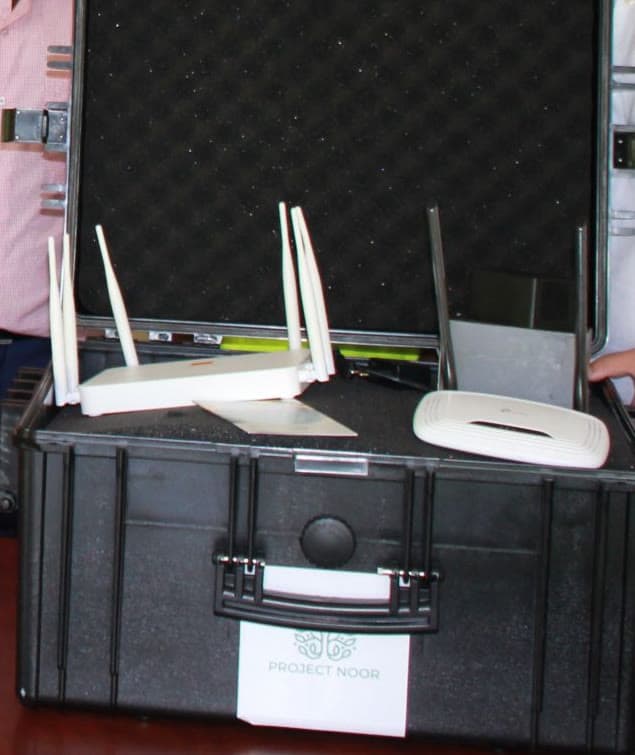
You open one ruggedized wheeled case. One person, minutes to the first lesson. No grid, no network, no technician.
The case is the product, not the packaging: transport container, charging hub and power-electronics enclosure in one, wired for twenty tablets and two servers off a single energy input.
Inside are two computers. A Raspberry Pi 5 serves the learning platform — curriculum, lessons, quizzes, progress — and an NVIDIA Jetson Orin Nano runs a large language model on the spot. That is the difference between a tutor that answers a child in a village with no network and a chat window waiting for a connection. It’s time to bring the future of education to everyone, everywhere.
The learning platform is our own: courses, lessons, quizzes that explain the answer, and each child’s progress. Because we write it ourselves it is cut to fit the case — not to fit the school with a permanent internet connection that off-the-shelf software is built for. It runs fully offline, in the case, with no connection out.
The server hub generates its own Wi-Fi, the tablets join it, and that is the whole network: a classroom intranet with no route to the open internet. A satellite receiver in the case takes content packages down from a broadcast, one way, with no return channel.
The content scales with the school: from primary school to vocational training, from big cities to the most remote regions. The case stays with the school that opens it — community owned, community managed.
Why does a feather fall slower than a stone?
Because the air slows it down. With no air, both fall at the same rate — that is the experiment in lesson 4. Shall we work through it together?
An illustration of the learning path — not a screenshot, and not a real lesson.
- AI tutor
- runs on the Jetson in the case — the answer comes from the room, not from the cloud
- Learning platform
- our own build, running on the Pi 5 in the case — with no connection of any kind
Both run offline. No network, no cloud, no connection.
The six layers
5Contentpre-loaded before shipment
4AItutor model, local on the Jetson
3Platformcurriculum, lessons, quizzes, progress
2Networkclassroom Wi-Fi intranet
1Hardwarecase, tablets, two servers
0EnergyPV, MPPT, LiFePO₄, BMS, distribution
Designed around the school day, not a spec sheet
A full school day, twenty tablets charged overnight, several days without sun, operation without technical training, and a price that allows a second order.
| Component | What it does |
|---|---|
| 20 × 10-inch Android tablets | One per learner; chosen for the educational-app ecosystem and durable low-cost models. |
| Local learning server — Raspberry Pi 5 | Hosts the curriculum, serves lessons and quizzes, records progress. |
| Local AI server — NVIDIA Jetson Orin Nano | Runs the tutor model on site, with no link to a cloud. |
| Classroom Wi-Fi, generated by the hub | A self-contained intranet with no route to the open internet. |
| Satellite receiver | Takes one-way content packages down from a broadcast; no return channel, no internet in the room. |
| Solar generation and storage | Runs the classroom for a full school day and several days without sun, and charges twenty tablets overnight. |
| Content, pre-loaded before shipment | The classroom downloads nothing and waits for nothing. |
Hardware block diagram
↔ Scroll sideways to see the whole diagram
Power path, data path, and the satellite path as a single downward arrow, each named in the legend. Inside the violet line, the energy and data architecture of the case; the component values are the lean configuration (560 Wp / 5.9 kWh / 24 V).
One case. Twenty children. Nothing to connect to.
Tell us where the first one goes.
Put a school in a boxPower · layer zero
We engineered the power layer into the product, so no school ever has to solve it on site.
Most digital-education systems arrive and ask the school for electricity. This one brings its own — engineered into the case, not sourced at the roadside.
Where there is no grid, power is whatever the local market has that week: panels of unknown provenance, car batteries, charge controllers built for something else. That is not a foundation you can put a school on.
So we took the job away from the school. Generation, storage, protection and distribution are engineered parts of the case, specified for the devices they have to run.
What the school does instead: open the lid, unfold the panel, teach. Nothing to source, nothing to wire, nothing to keep alive between visits.
The principle the power layer is designed to:
A deployable product cannot improvise its energy system on site. It has to be pre-engineered and built in — part of the school-in-a-box, not a job for the school.
Khaoula Tahir engineered the energy system as an accredited electrical-engineering bachelor project at Rheinische Hochschule Köln (2025).
The technical packThe component-level design: the load-driven sizing, the modular split, the costed bill of materials and the full academic citation.
The design starts at the load, not at a catalogue: every device in the case carries a power figure and a daily duty cycle, and the array and the pack are sized from the total.
Generation. Two semi-flexible monocrystalline modules in series, chosen to hold the maximum-power-point voltage high enough for efficient tracking when the cells are hot. Against PWM, MPPT returns 10 to 30 % more energy — with array area constrained, the difference between one panel and two.
Storage. LiFePO₄, for safety before cost: the phosphate structure holds oxygen far more tightly than cobalt-oxide chemistries, so thermal runaway is much less likely — decisive for a sealed case in a hot room. The cells are specified at 4,000 or more cycles at 80 % depth of discharge, cobalt- and nickel-free.
Sized with headroom
Lean configuration — staggered charging
1,540 Wh/day- Photovoltaic
- 560 Wp
- Storage
- 5.9 kWh at 24 V
- Autonomy
- 3 days
- Bill of materials
- €1,245, costed
Conservative configuration — simultaneous charging
3,913 Wh/day- Photovoltaic
- ≈ 1.4 kWp
- Storage
- 10.3 kWh at 48 V
- Autonomy
- 2 days
- Cell mass
- ≈ 1.75 × the lean configuration
The conservative configuration is sized for simultaneous charging, including through a Sierra Leonean rainy season, May to November; the lean configuration is sized for staggered charging. The bars show daily energy demand. The conservative bill of materials is fixed with a manufacturing partner against your load measurement.
In the lean configuration the energy subsystem alone weighs about 45 kg, of which 33 kg is cells. The design therefore splits into a battery-and-electronics unit at 35 to 38 kg and a folding PV unit at about 8 kg.
The conservative configuration needs roughly 1.75 × the cell mass of the lean configuration; we fix the final split against your load measurement.
| Component | Selection | Qty | € each | € total |
|---|---|---|---|---|
| PV module | Semi-flexible monocrystalline, 280 Wp | 2 | 175 | 350 |
| MPPT charge controller | Victron SmartSolar MPPT 100/30 | 1 | 215 | 215 |
| LiFePO₄ cells | EVE LF230, 230 Ah / 3.2 V | 8 | 50 | 400 |
| Battery management system | JK BMS B2A8S20P, 2 A active balancing | 1 | 115 | 115 |
| DC-DC buck, 5 V ≈ 15 A | high-efficiency module | 1 | 25 | 25 |
| DC-DC buck, 19 V ≈ 3 A | adjustable module | 1 | 10 | 10 |
| DC-DC boost, 48 V ≈ 2.5 A | adjustable module | 1 | 20 | 20 |
| Busbars, cables, lugs, connectors, fuses | sundries | — | — | 110 |
| Subtotal, lean configuration | €1,245 |
The energy layer is costed in full. Devices, case and assembly are fixed with a manufacturing partner.
Full citation: Tahir, K. (2025). Project Noor: Empowering Education Through Autonomous Solar-Based Energy Systems. Bachelorarbeit, Rheinische Hochschule Köln, Elektrotechnik, Modul Bachelorprojekt (PA7). First examiner: Dr. Peter Giesert.
Unlocking education beyond connectivity
Content comes down. Nothing goes up. The classroom never touches the internet.
One-way content delivery, not a broadband service. That decision is as pedagogical as it is technical — and it is why a child-welfare partner can sign off on this room.
The obvious answer to a school with no network is to give it a network. We deliberately did not. A broadband terminal in a village school is a live commercial relationship with a global carrier, and it hands a school the whole open internet to police.
The architecture is a one-way broadcast content path. The receiver wakes for a short window, takes a content package down, and sleeps. Nothing goes back up.
The whole receiving end lives in one case: receiver, learning server, AI server, Wi-Fi access point, and the power to run all four.
There is no return channel. Content arrives as a package and stays local, so “no internet required” is literally true in the classroom — and there is no route out on which a child can be exposed.
The content-delivery architecture
↔ Scroll sideways to see the whole path
How the one-way path is designed, from the broadcast side to the tablet. No arrow runs back up.
DVB-NIP (native IP over DVB) · GSE / MPE encapsulation · DVB-S2 / S2X modulation · multicast ABR · classroom Wi-Fi intranet
Real solutions for tangible impact · Kathadungbu, December 2024
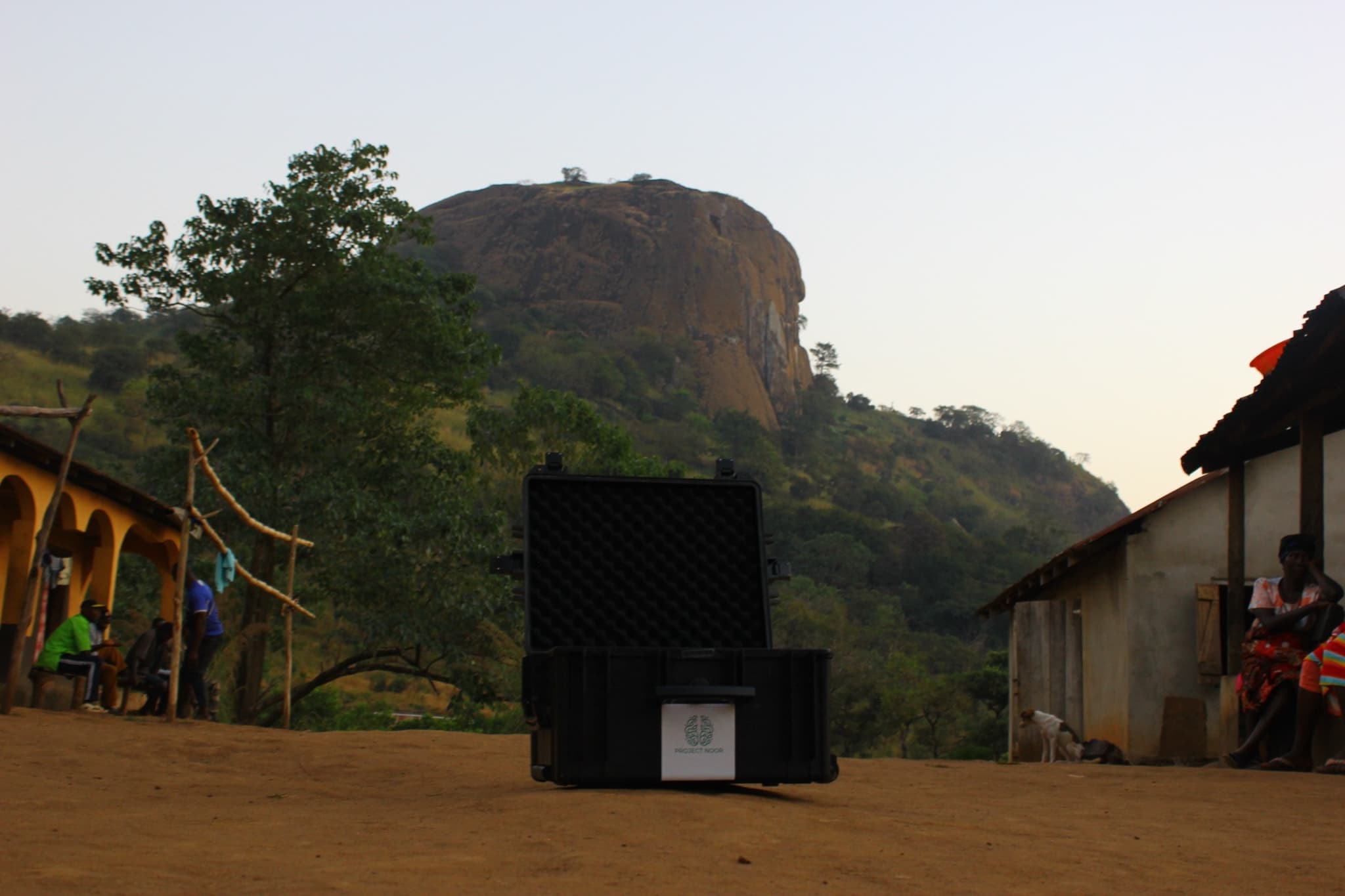
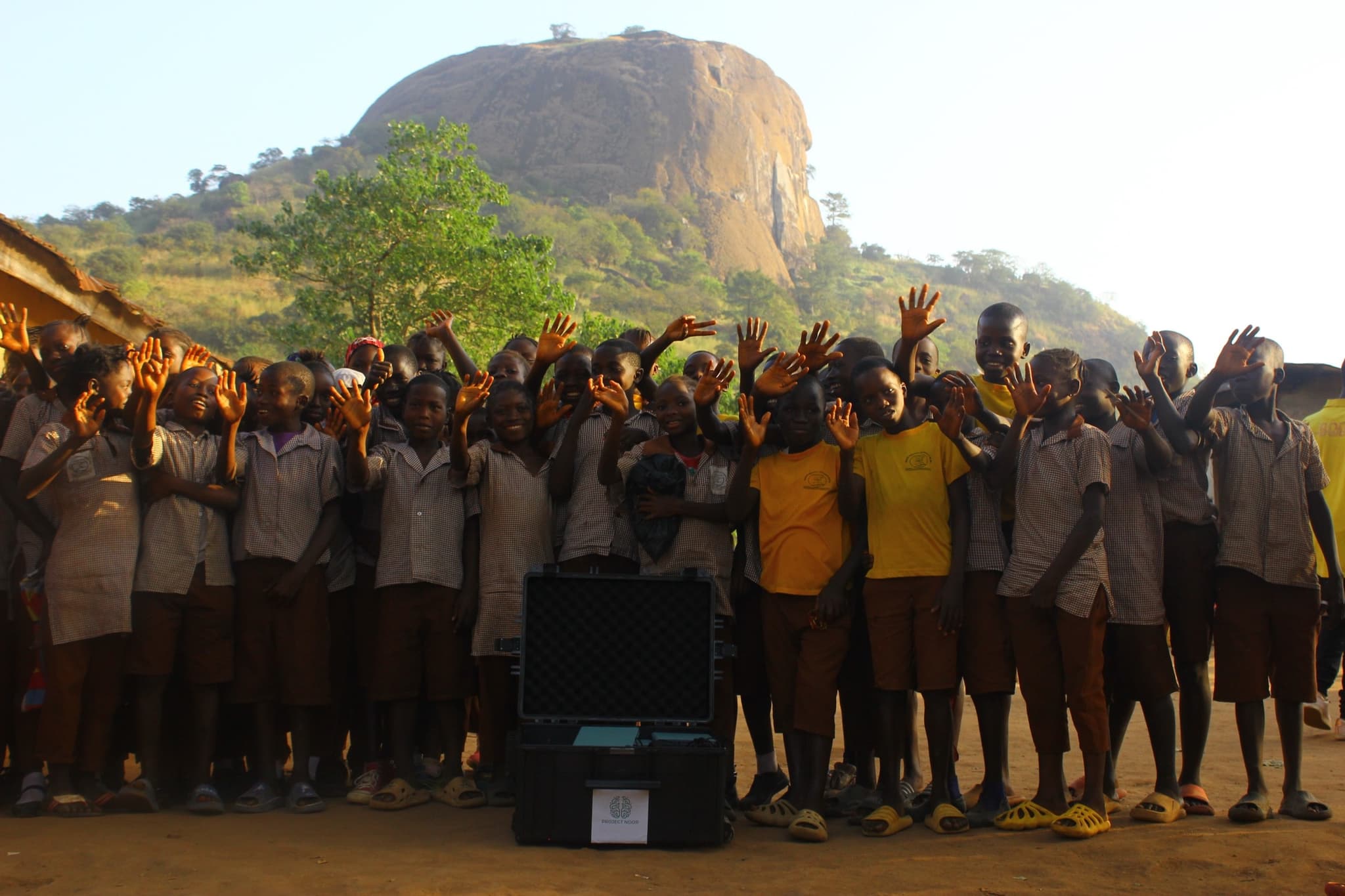
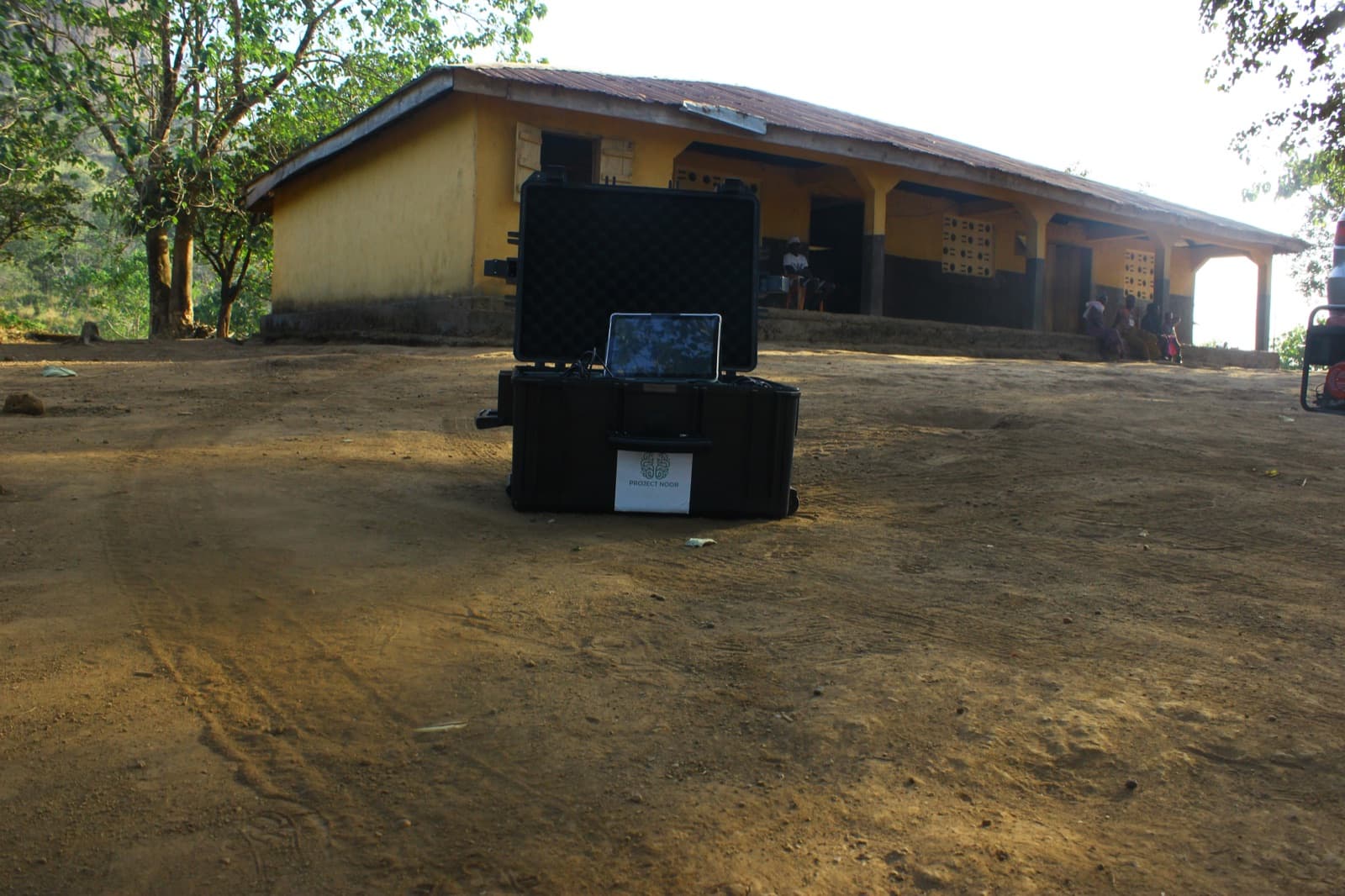
One case went two hours past the end of the paved road, and it is still teaching there.
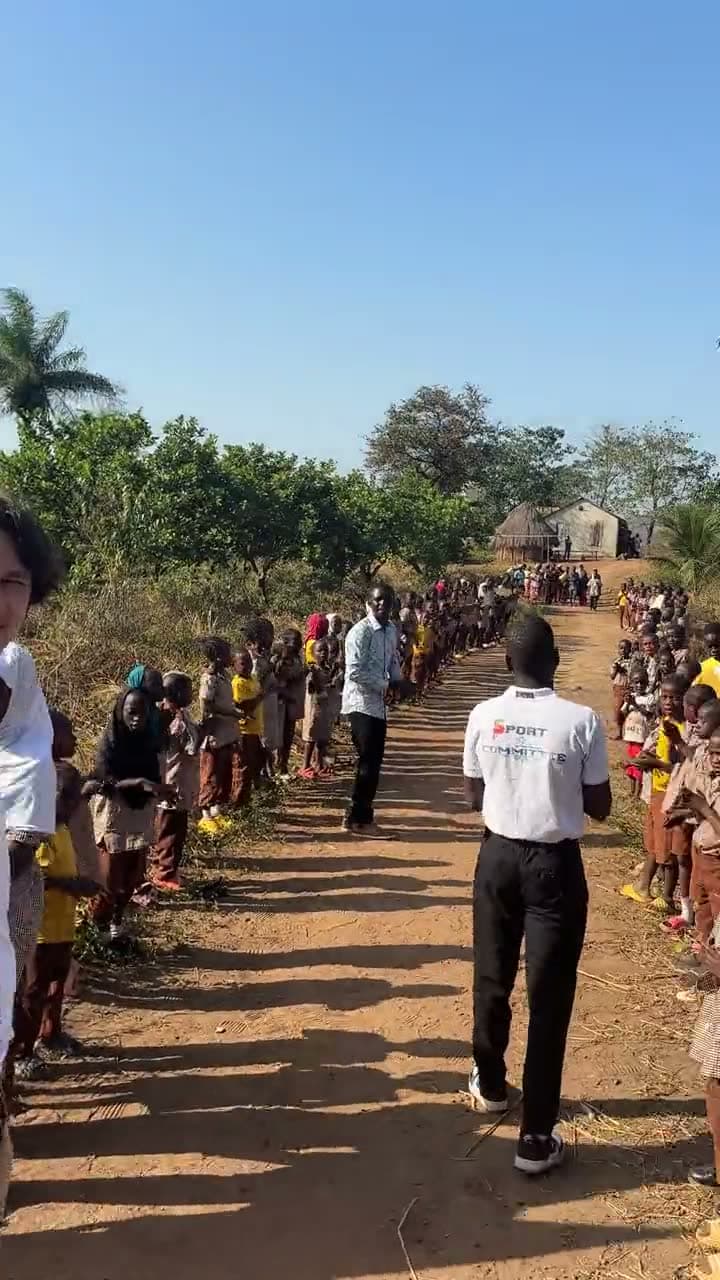
Kathadungbu, northern Sierra Leone, roughly two hours from Makeni, chosen because it had neither grid power nor a network. Installed December 2024. Still running today.
Our vehicle broke down and we arrived late. A line of children met us with a song of welcome, and the elders of Kathadungbu stood with them. We installed the case in the last of the daylight.
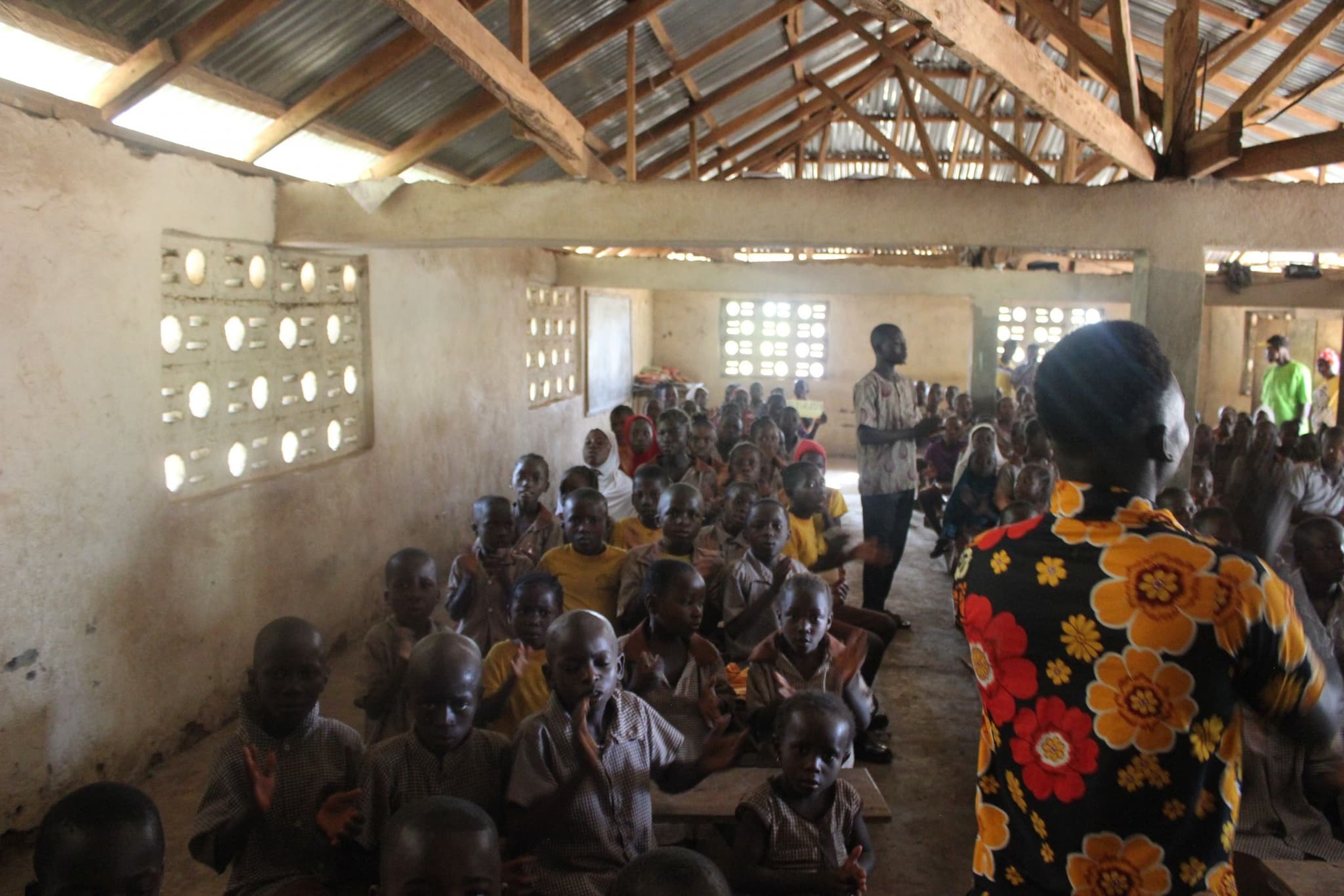
Children who had barely touched digital technology took to the lessons within minutes, and the AI tutor gave the one-to-one attention a single teacher in a room of a hundred cannot.
The case is teaching in Kathadungbu today.
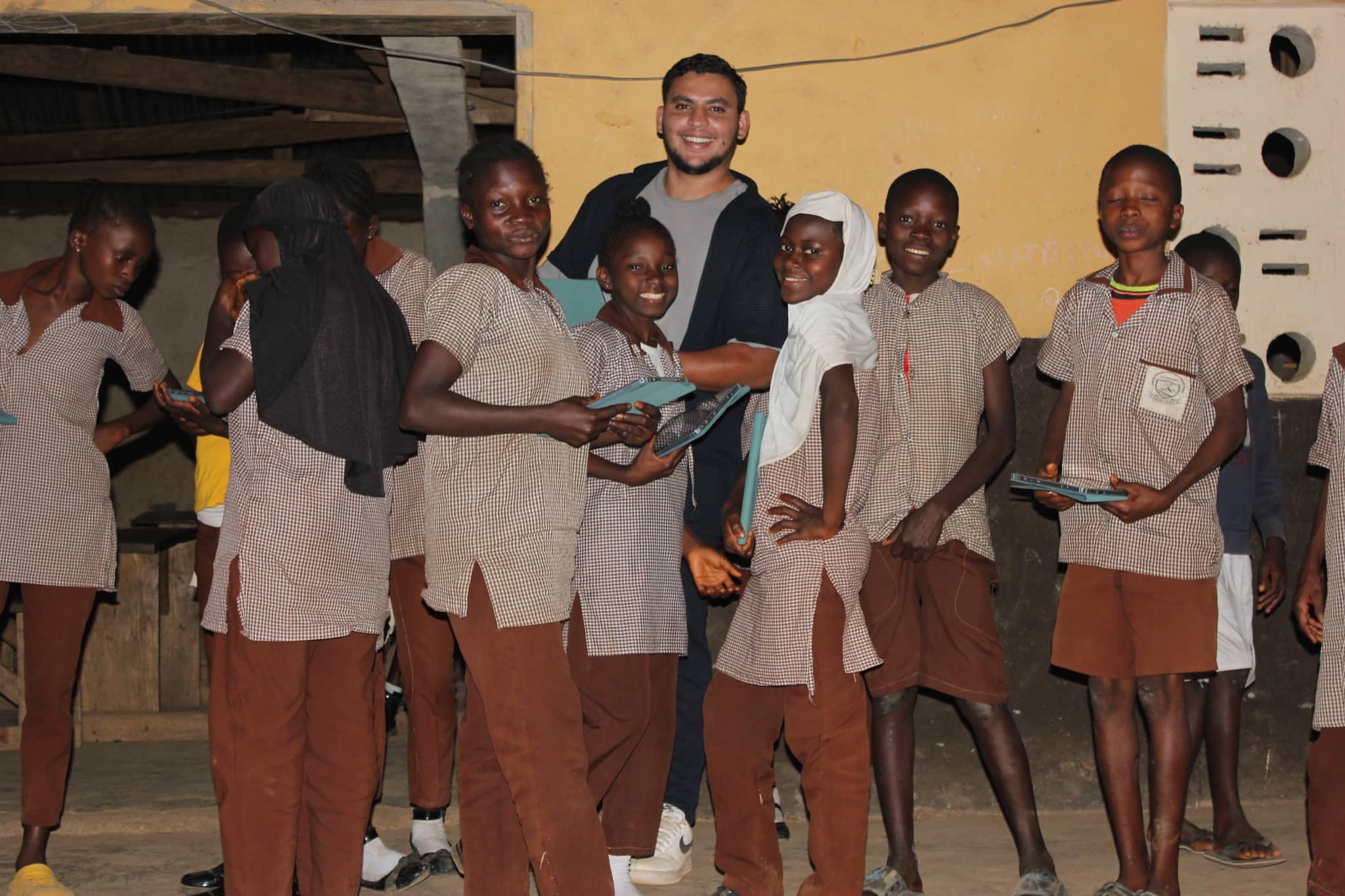
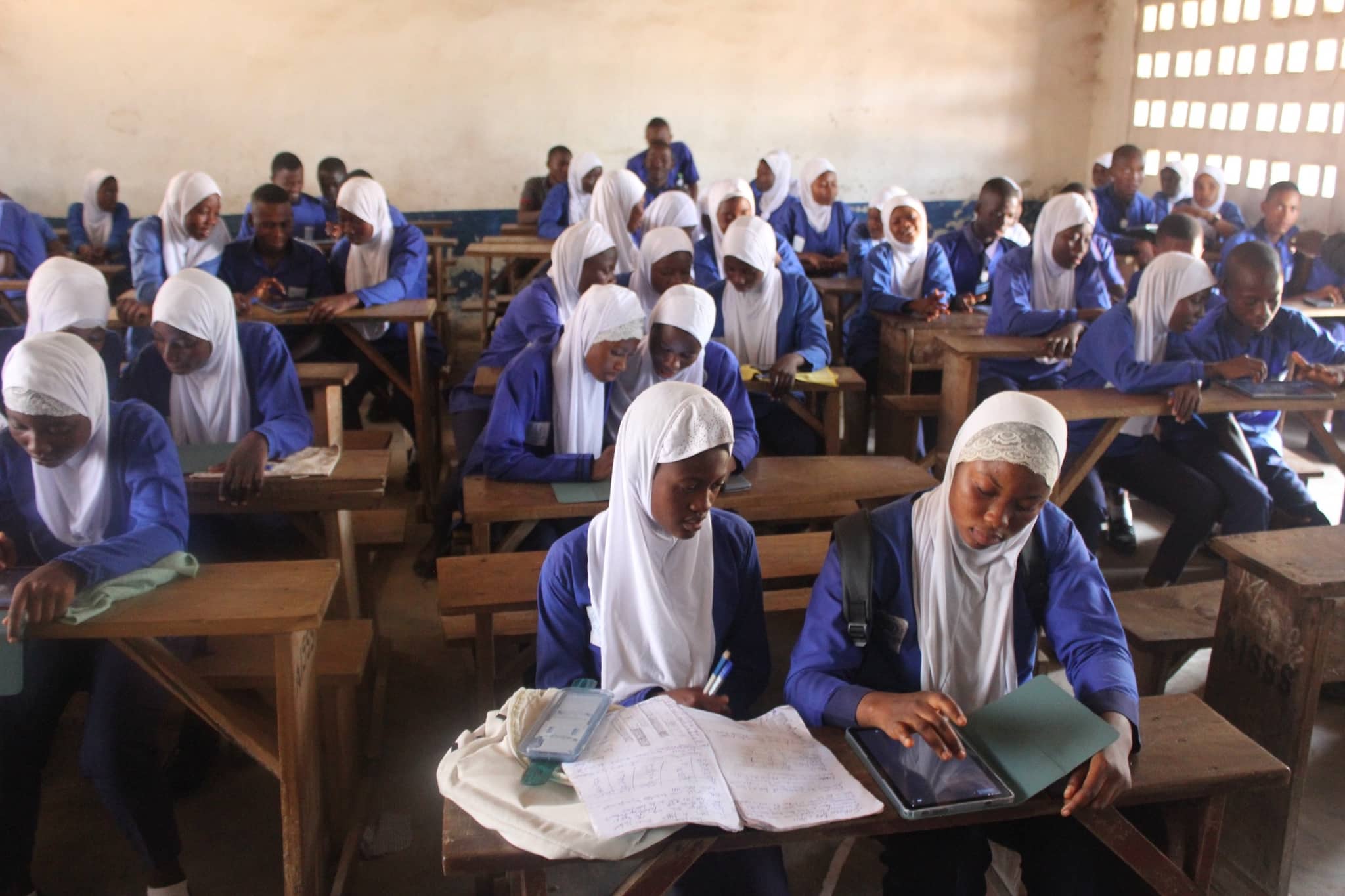
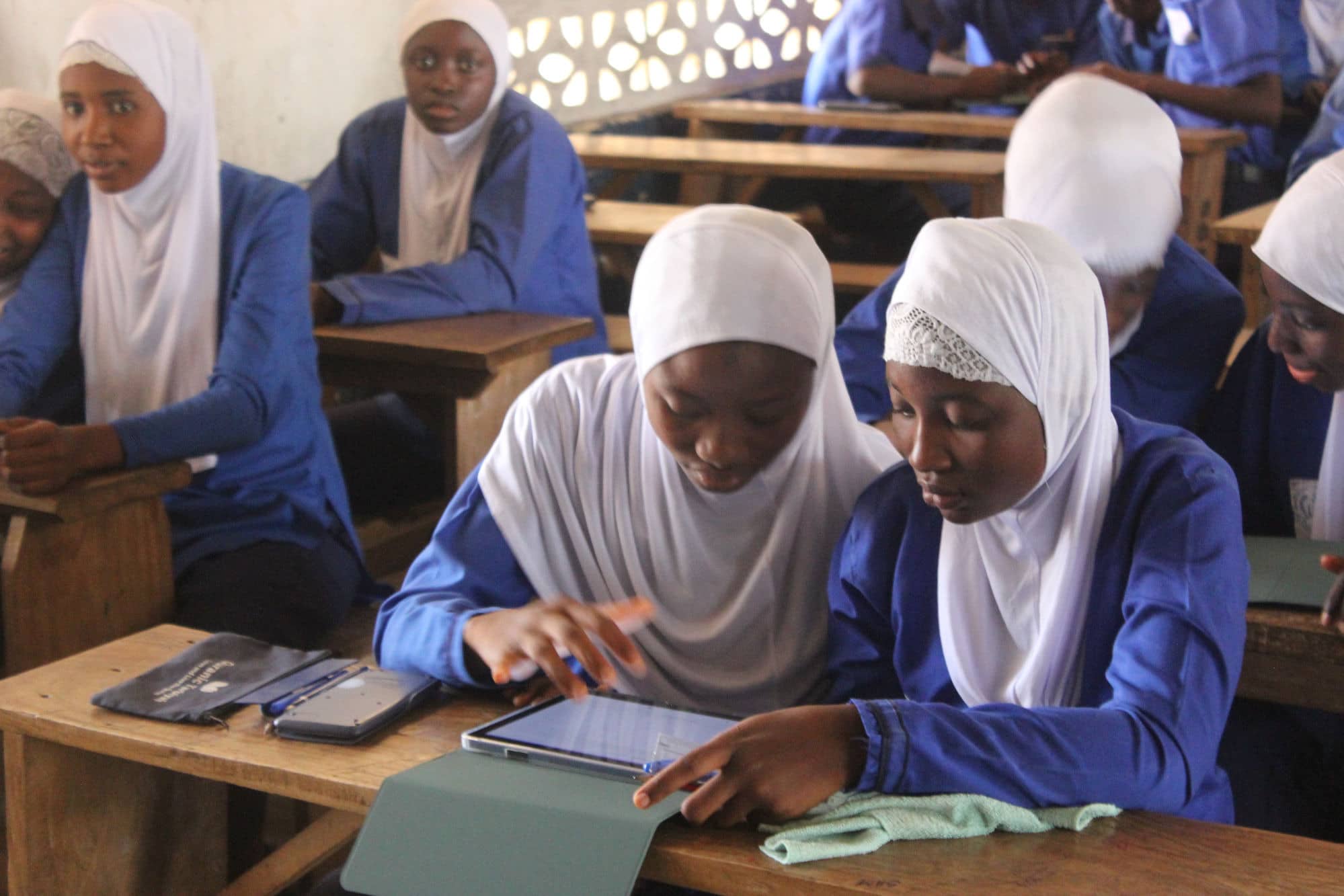
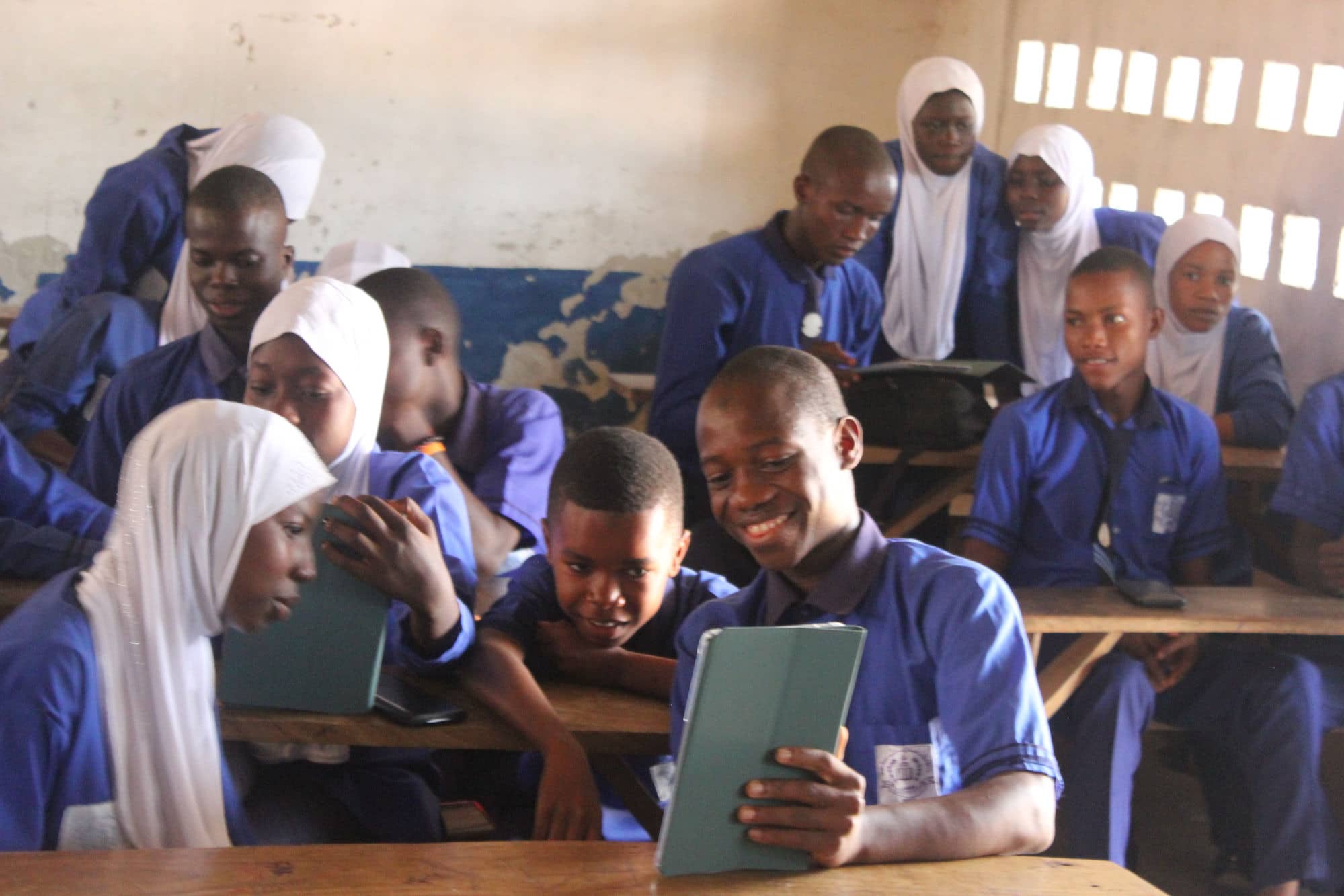
“Project Noor’s solution has transformed education here, giving our students a chance to learn like never before.”
Numukeh Koroma, Principal, AISSS Makeni
The next one costs €5,000.
Put a school in a boxCape Town · 29 September 2025
Gold. First place, “Innovations for Connectivity”, at the G20 ICT SMME Awards.
Sixteen countries, six categories, 26 to 29 September on the V&A Waterfront. On the last night they called Project Noor.
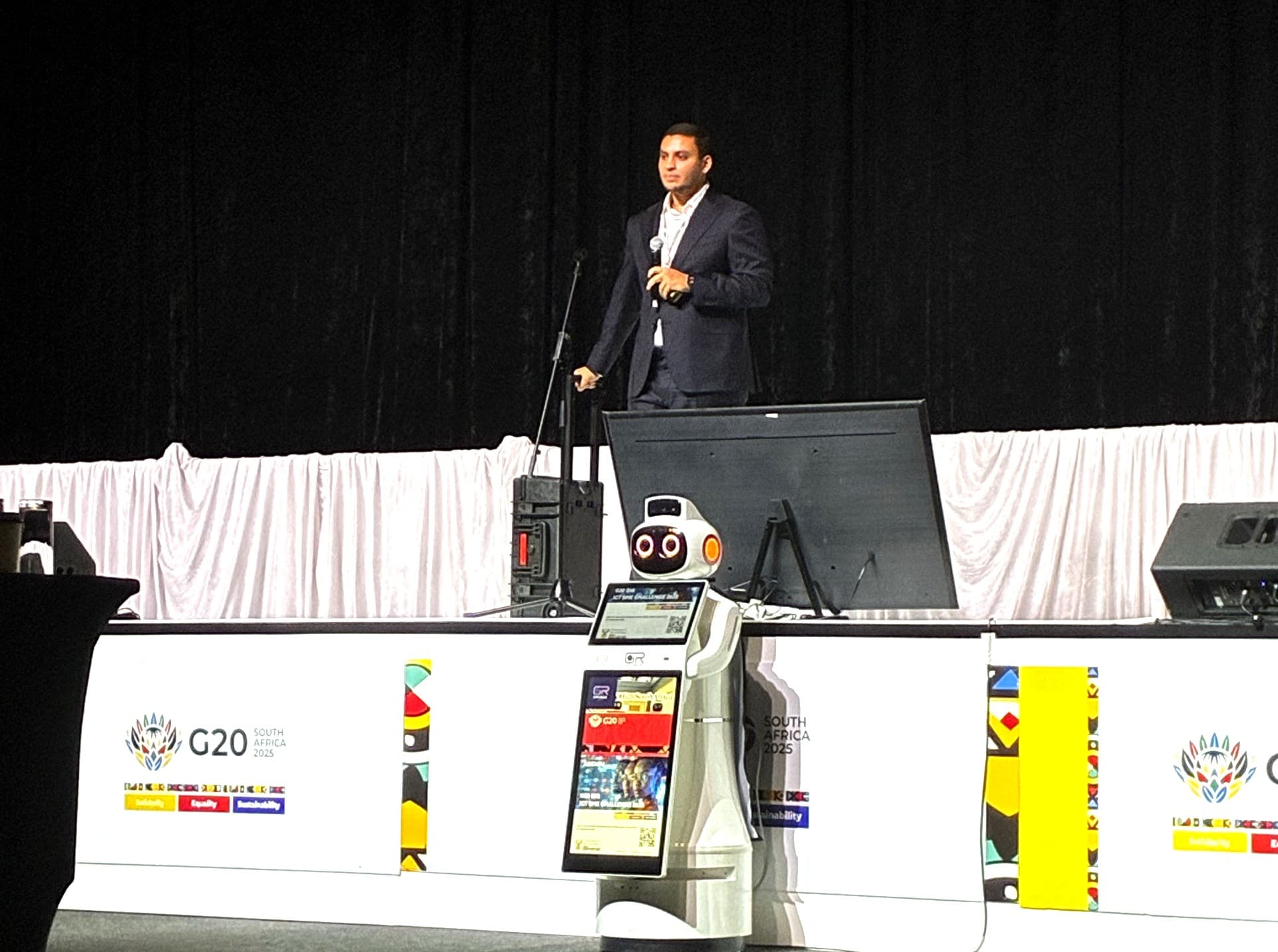
One person, one handheld microphone, one stage under full G20 South Africa branding.
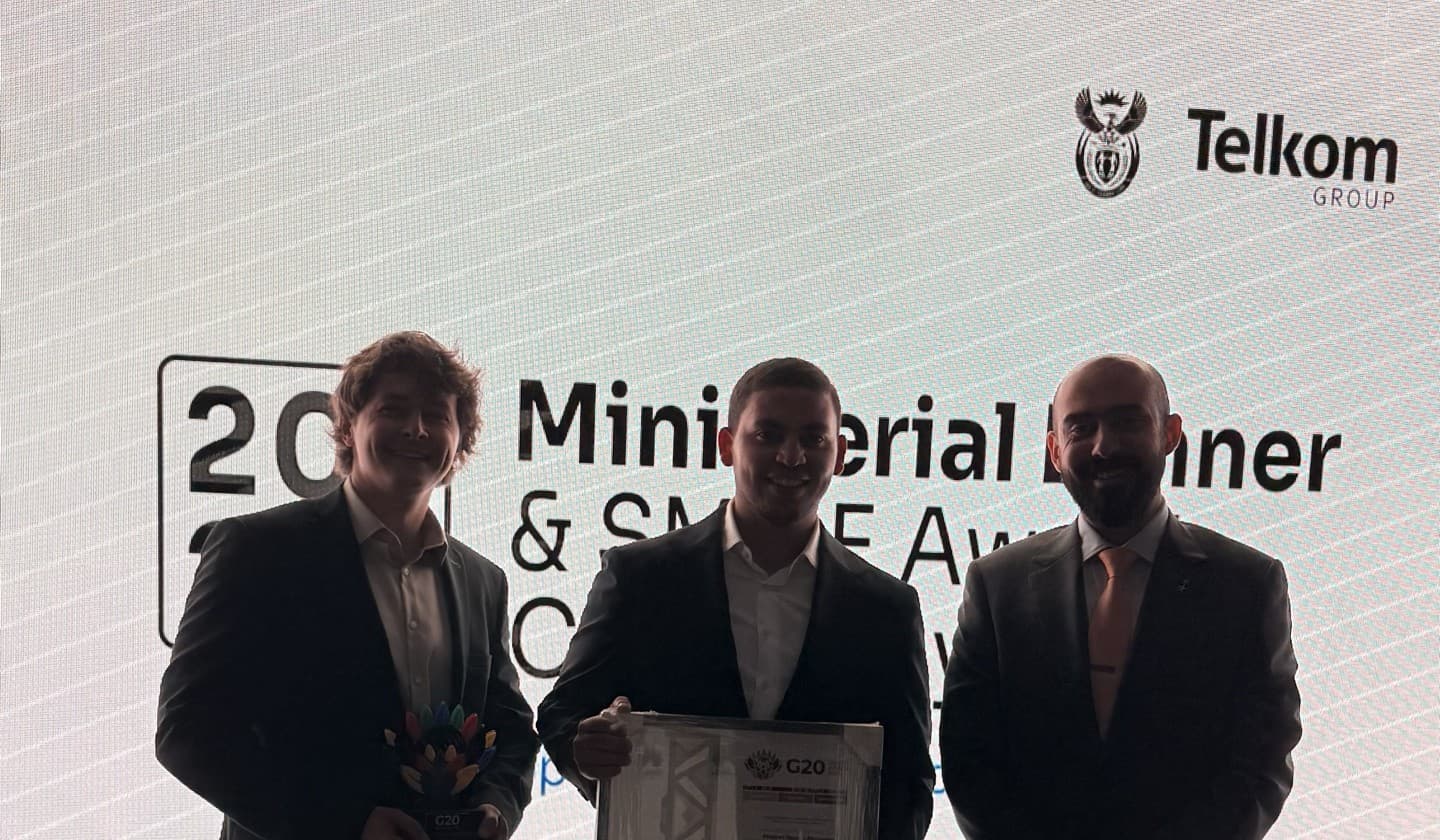
On the Monday, at the Ministerial Dinner and SMME Awards Ceremony, Hon. Solly Malatsi, South Africa’s Minister of Communications and Digital Technologies, handed over the gold.
A panel of six judges drawn from Nokia, Microsoft, IBM, Google, Meta and AWS picked the winners. Ours was the connectivity category.

From the media report of the South African Department of Communications and Digital Technologies:
“Innovations for Connectivity — Winner: Project Noor (Germany). Bridging the digital divide with smart, scalable connectivity solutions.”
The verdict
Judges from six international technology companies put a solar-powered case for twenty children first.
The pitch deck
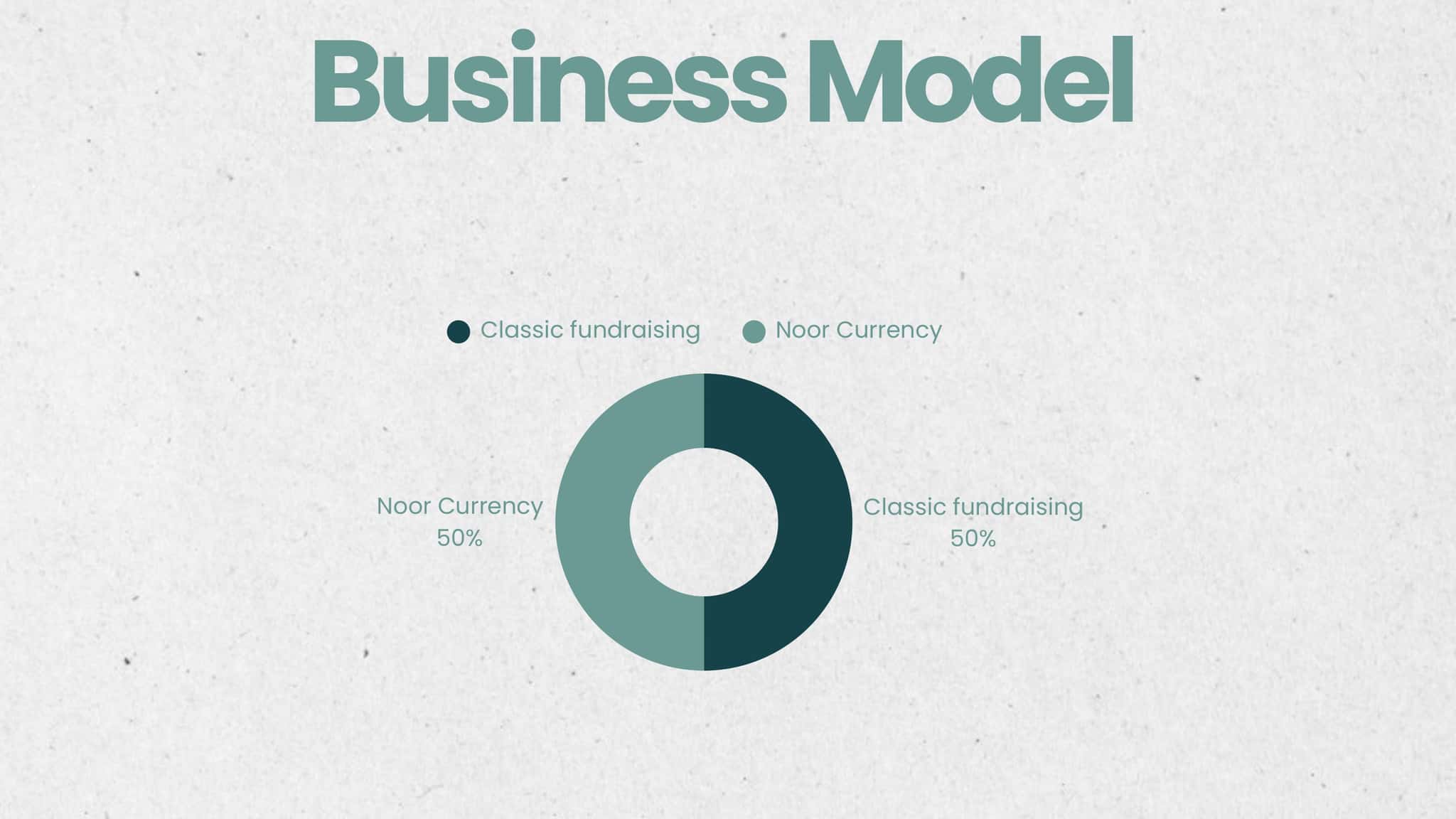
From the pitch that won Gold — G20 ICT SMME Awards, Cape Town, September 2025.
€5,000 puts the next one anywhere on earth.
Put a school in a boxLondon · Nairobi
London heard the argument. Nairobi took it to the then Vice-Chancellor.
An AI research lab in London, Germany’s then Vice-Chancellor in Nairobi — the same case, the same argument.
The AI for Learning Forum met in London on 11 November 2025, in Google DeepMind’s offices, around one question: what AI does to learning.
In the session Transcending Barriers, Rafael Mello, Professor at CESAR School in Recife and a lead researcher of the AIBox AI lab, spoke alongside Yassine Bekri of Project Noor.
In Nairobi in 2024, four of the twenty German startups at the 5th German-African Business Summit spoke with the then Vice-Chancellor, Robert Habeck. Project Noor was one of them.
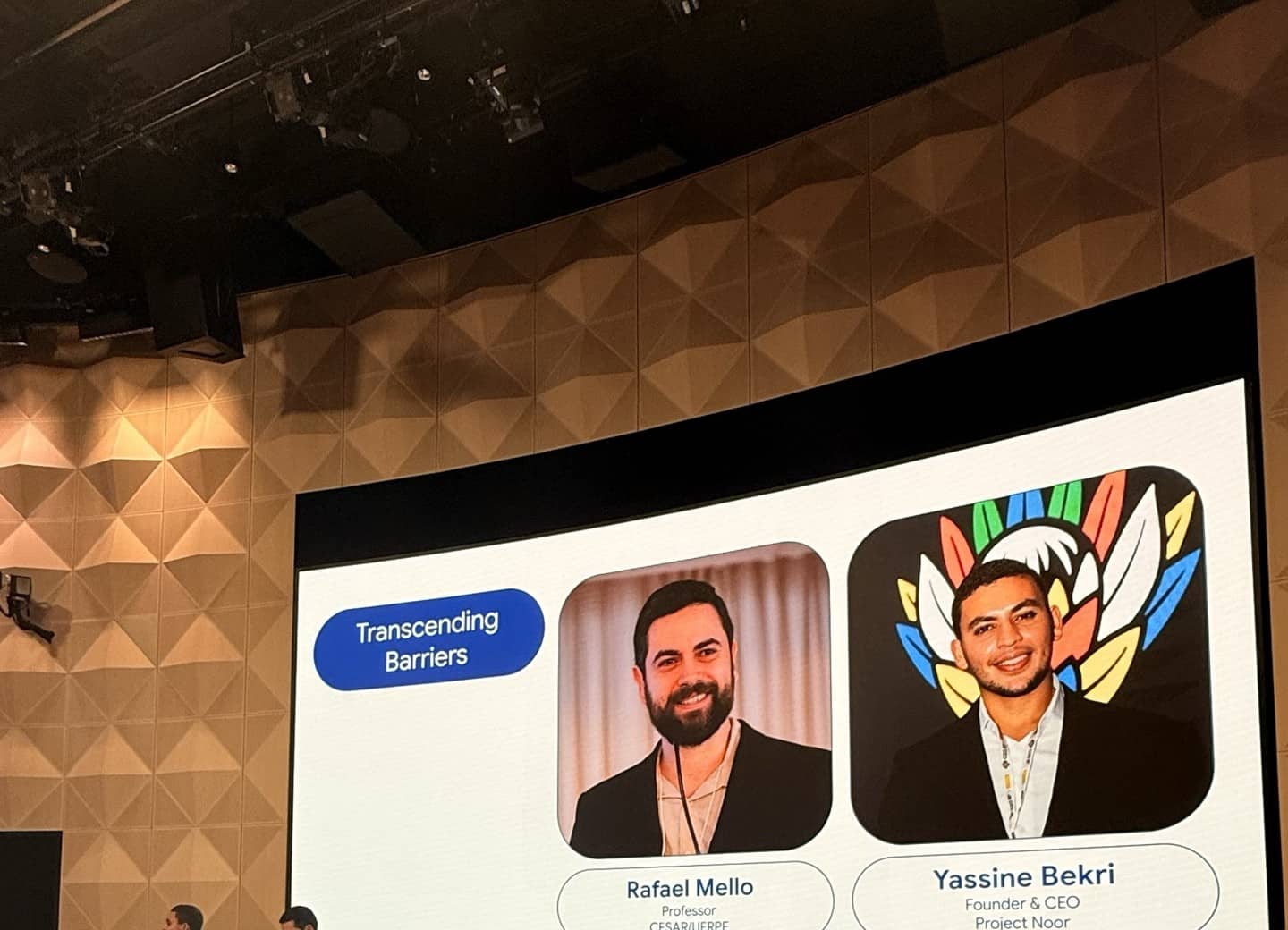
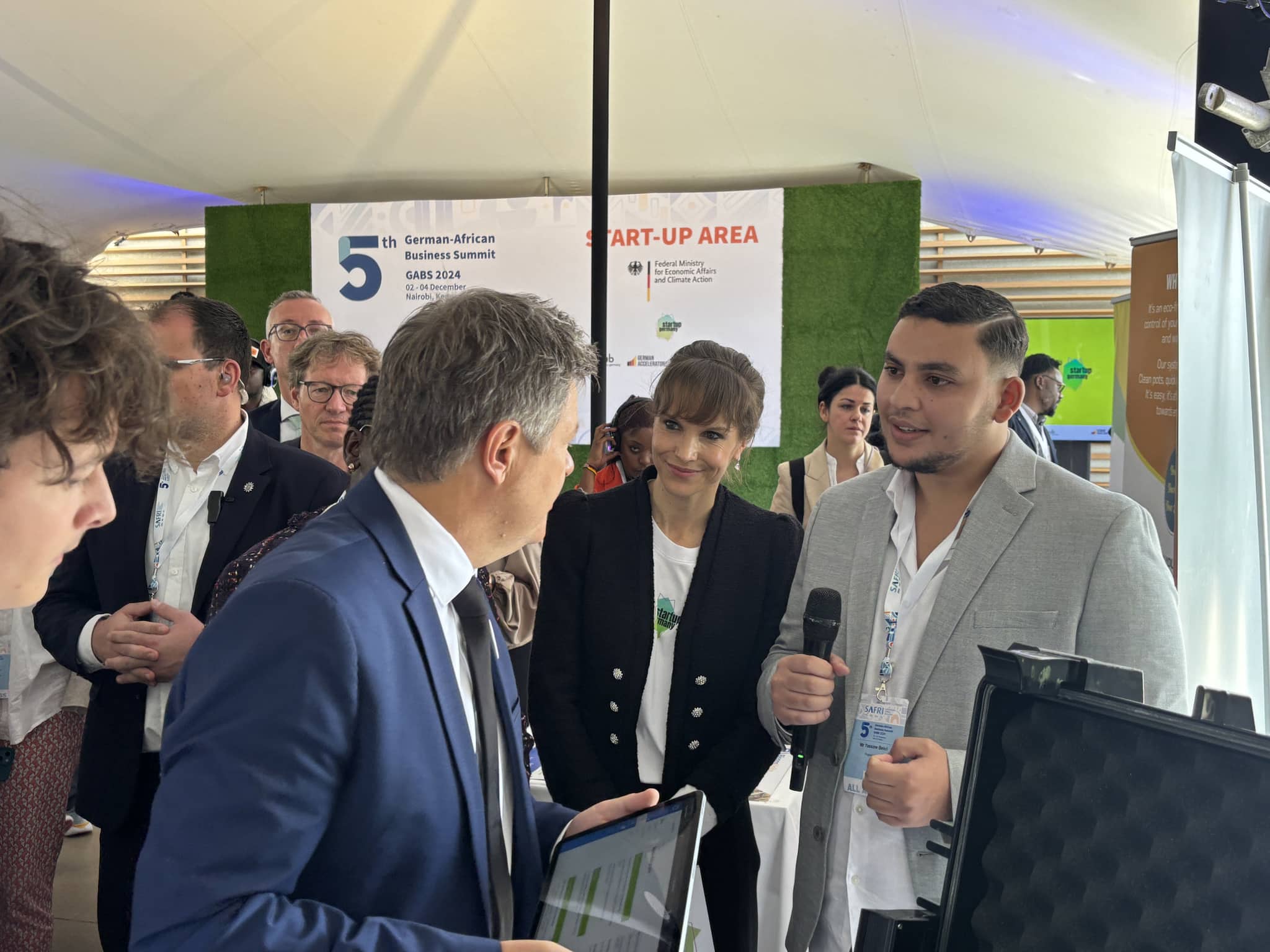
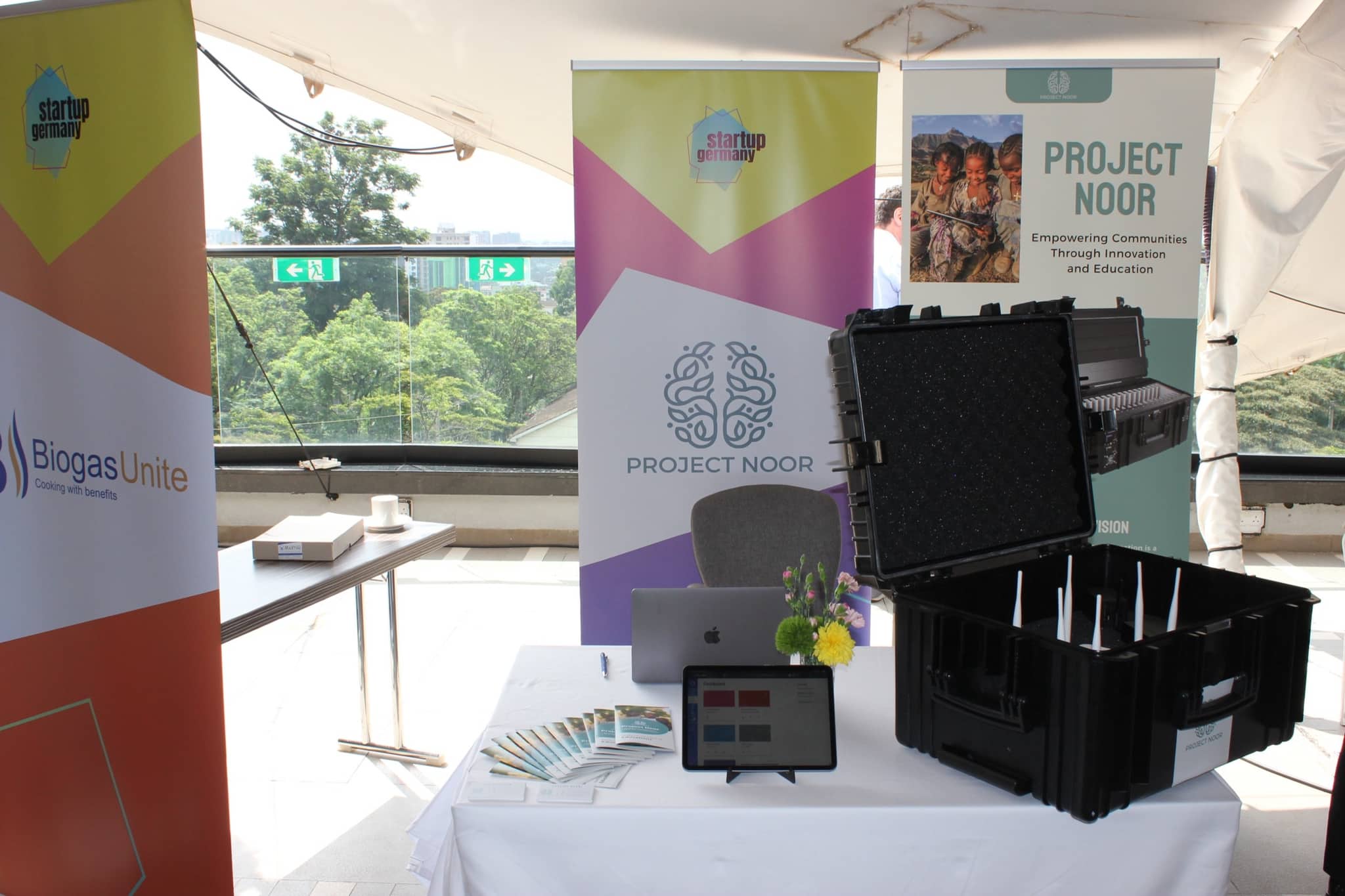
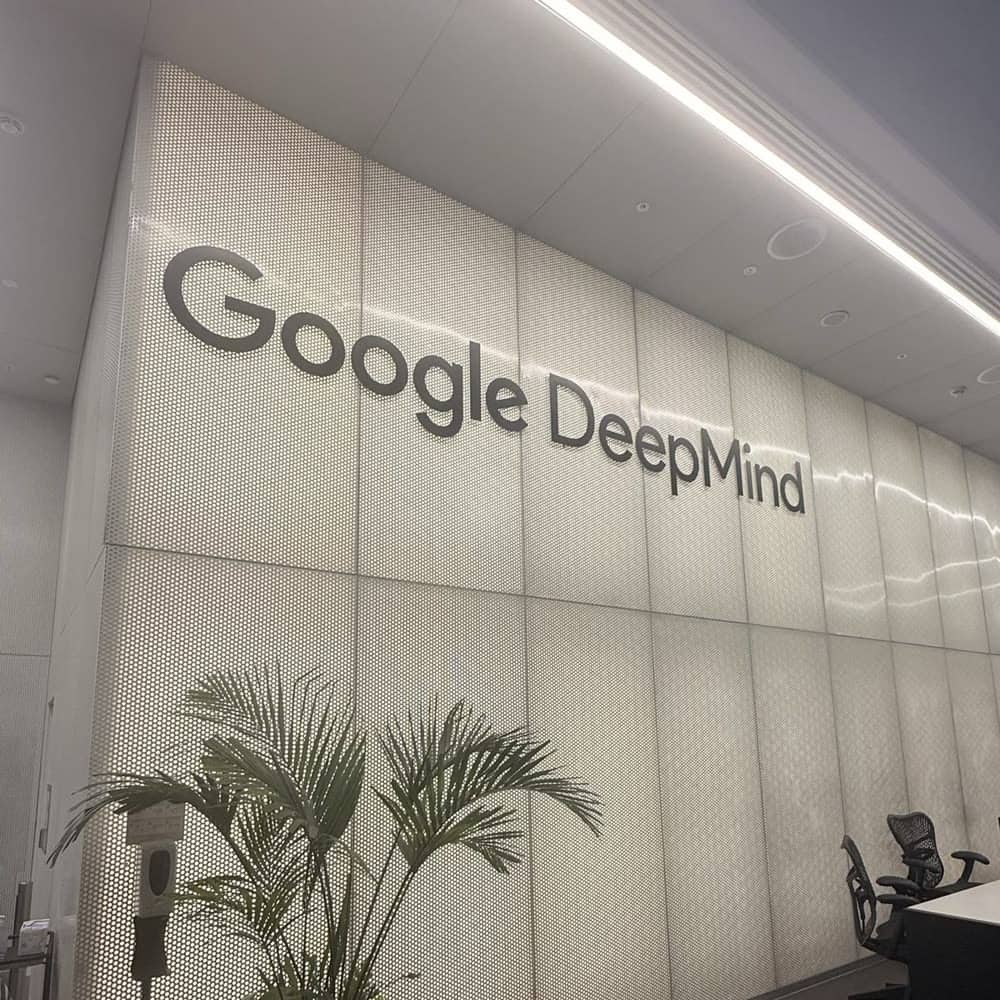
Two rooms, two kinds of scrutiny. The answer did not change.
Ask us the hardest question you have.
Put a school in a boxWho we are
Two founders, one engineer, and a company you can contract with.
Small on purpose. The three people named here built everything on this page.
Yassine Bekri and Nik Kuchler met on the first day of their computer-science degree in Düsseldorf and went on to a master’s in AI and data science. Yassine grew up in Morocco and spent nearly four years at a Don Bosco school in Kenitra; the idea for Noor came from traveling in Ethiopia. Nik builds the platform.
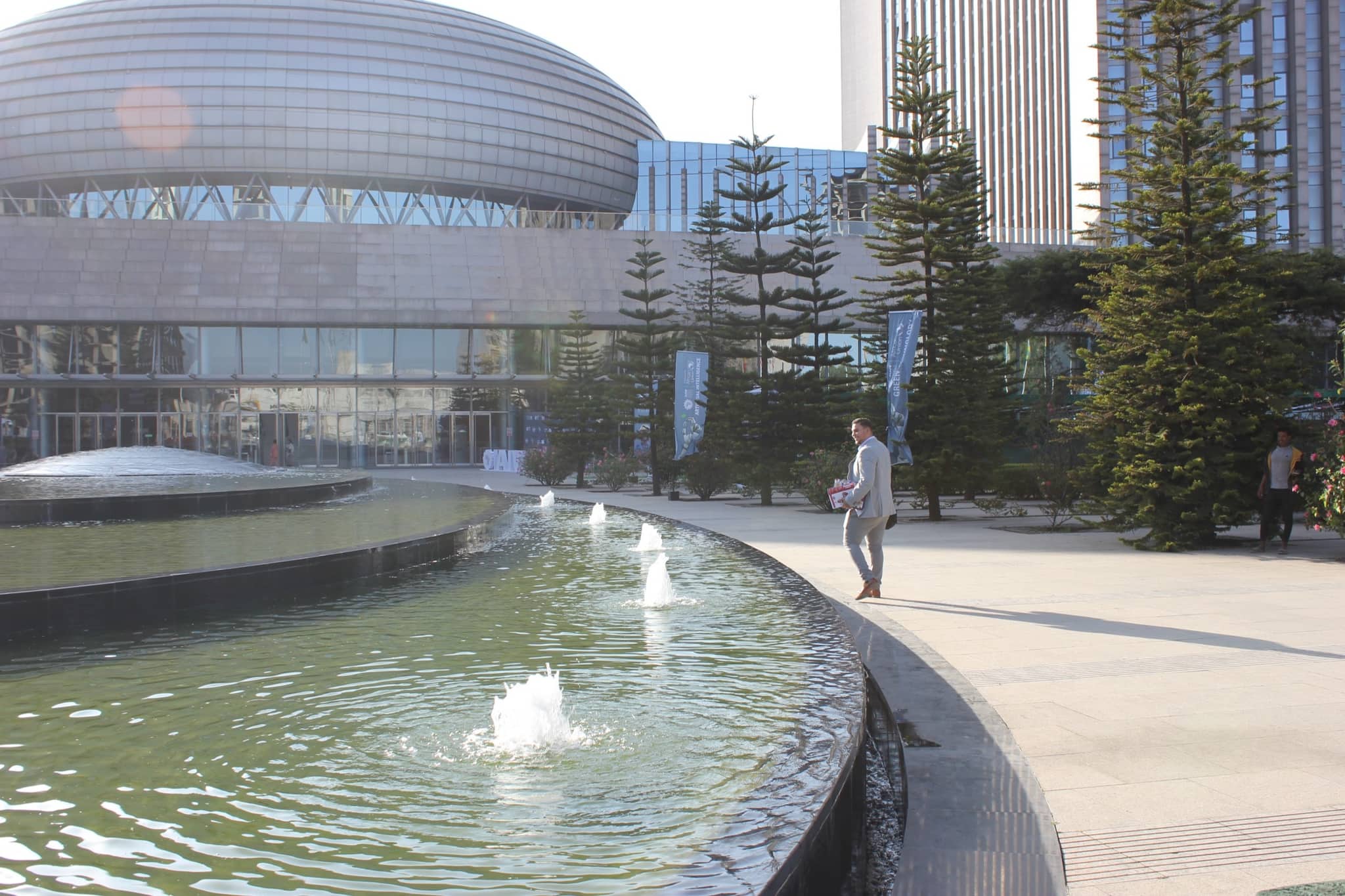
Between them they installed the first case in Kathadungbu themselves, ran a controlled test at a solar-technician training center in Kenya, and carried the argument to Cape Town and London.
Khaoula Tahir engineered the energy system as an accredited electrical-engineering bachelor project at Rheinische Hochschule Köln; her name sits behind every number in the power section.
Project Noor is operated by ArisEd GmbH, Düsseldorf.
Funded by

 recommendation
 support
Put a school in a box
€5,000 puts a school in a box anywhere on earth.
Twenty children, one classroom, one case. Here is where the money goes, and the three roles a partnership can start in.
We price in classrooms, not seats. One case is a complete classroom for twenty students — bought once, with content digitisation, installation and training included.
And because every foundation board asks: financed from project funds, executed as a paid order — not a donation. Assembly and electrical fit-out belong in a training workshop in the region the boxes serve, so the value stays in the country.
Tell us the number and the region and we come back with a build plan.
| Cost line | Costing |
|---|---|
| Energy system, lean configuration (560 Wp / 5.9 kWh / 24 V) — PV, MPPT charge controller, LiFePO₄ cells, BMS, DC-DC, cabling and protection | €1,245 · costed from the bill of materials |
| Devices and servers · case and assembly · freight, customs and spares · battery replacement · content digitisation, installation and training | Fixed with a manufacturing partner before the first order |
€1,245 is costed line by line from the lean-configuration bill of materials. The remaining €3,755 covers devices and servers, case and assembly, freight, customs and spares, battery replacement, and content digitisation, installation and training — fixed with a manufacturing partner before the first order, and we work the cost model through with you on that bill of materials.
Three roles
Build
Build the next box closer to the school it is going to — assembly and electrical fit-out in a regional training workshop. Community owned, community managed.
Fund
Fund named classrooms. €5,000 per classroom, into schools you choose.
Next step
Deploy
Bring the schools and the curriculum. We digitize the content: you provide the content, we take care of the rest.
What you get
A case teaching in Sierra Leone today, installed in December 2024 — and the design, the costed bill of materials, the platform and the AI stack behind it.
The ask
“The great aim of education is not knowledge but action.” — Herbert Spencer.
The next action is the next classroom: €5,000, one case, twenty children, built closer to the school that opens it. We reply within two working days. Write to y.bekri@arised.org.